Skip to content
Subscribe

Competitive Elections Are Key To Reducing Partisanship

Published:

Donor Partisanship // Credit: Sunlight Foundation
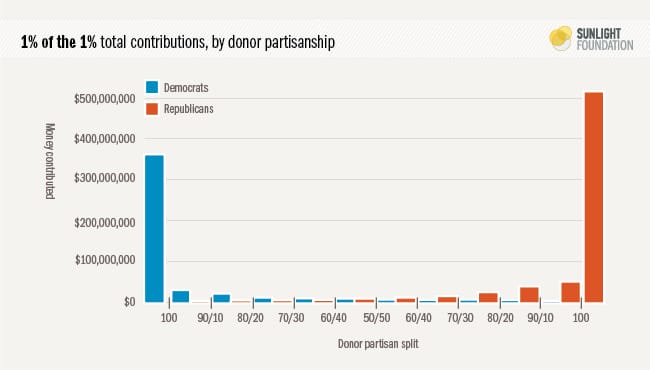
Credit: Sunlight Foundation

A study by the Sunlight Foundation titled "The 1% of the 1%" released on Wednesday. It analyzed political donations from the top 31,385 donors to the House of Representatives during the last election cycle. A startling picture of how political fundraising breeds partisan decision making is included in the findings.

The above graph illustrates how donors on the ends of the political spectrum are more likely to contribute significantly more than moderate voters. Thus, the more polarizing donors act as a filter between candidates and the larger population, shaping the 'agenda' of issues and legislation that is discussed, as well as their voting habits.

"For both parties, the more extreme the candidate, the more they depend on small donations (under $200)," the study found.

There is also a statistically significant correlation between dependence on large donors and more conservative House Republicans, and a slight moderating effect on House Democrats, though not statistically significant. For House Republicans, both large and small donors lead them farther right, when measured against the Nominal Three-Step Estimation method, which gauges partisanship.

This phenomenon does not stop with candidates, parties are going to the same donors to fund their committees. Likewise, an increasing percentage of committee funds is coming from the top '1 percent of 1 percent.'

"In 2012, the National Republican Senatorial Committee raised more than half (54.2 percent) of its $105.8 million from the 1% of the 1%, and the National Republican Congressional Committee raised one third (33.0 percent) of its $140.6 million from the 1% of the 1%... The Democratic Senatorial Campaign Committee raised 12.9 percent of its $128.9 million from these top donors, and the Democratic Congressional Committee raised 20.1 percent of its $143.9 million from 1% of the 1% donors."

So what remedies are available to help reduce the polarizing impact of political fundraising?  'Safe' districts, where competitive elections are rare, breed more partisan candidates. One conclusion of the study was, "A safer seat is associated with more extremist voting patterns in both parties. Going from a margin of victory of just a few votes to winning all of the votes predicts a shift of 17.3 points to the extremist end of the scale for Democrats, and a shift of 8.8 points to the extremist end of the scale for Republicans."

By increasing the number of competitive districts, even with the inherent nature of political fundraising, 'extreme' politicians will be less prevalent. Representatives can't afford more extreme positions in competitive districts. Although fundraising will always be a part of the political process, more competitive elections can mitigate its inherently polarizing consequences.

Adhere to the IVN etiquette

By posting a comment, you agree to adhere to our etiquette rules: No partisan attacks, no personal attacks, substantiate your sources, no self-promotion.

Contact IVN

Questions about this article or our coverage? Send us a message. A free IVN member account is required.

Message sent

Thanks, we’ll review it and get back to you if needed.

Message not sent

Sorry, something went wrong. Please try again.

Sign in to send a message

Messages are tied to your IVN member account. Signing in is free and takes a few seconds.

Republish this article

Republishing guidelines

Republish IVN articles for free. Independent Voter News articles may be republished online or in print under a Creative Commons BY-NC-ND 4.0 license, on these terms:

  1. Credit the author and IVN. Keep the byline ("By Author Name, Independent Voter News") and the attribution note at the end, which links to the original.
  2. Keep the meaning. You may update time and place references and apply your house style. You may trim for length, as long as the cuts don't change the meaning or misrepresent the author. Keep the headline. Mark any additions as your own (for example "Additional reporting by ...").
  3. Translations are welcome. Translate faithfully, add "Translated from English by [your outlet]", and tell us at editor@ivn.us.
  4. Keep the links, including the link to the original article.
  5. Keep the tracking image. The HTML includes a 1-pixel image that counts readers on your page. It collects no personal information.
  6. Photos and illustrations. Images credited to IVN may be used with this article only. Images credited to others (AP, Getty, Unsplash, Wikimedia and so on) stay under their owners' terms. Secure the rights or switch "Include images" off.
  7. Don't sell it. You can't sell our articles or sell ads specifically against them. Your normal site advertising is fine.
  8. No implied endorsement. Don't suggest that IVN or the author endorses you, your candidates or your causes, or that donations to you support IVN.
  9. Keep labels. Opinion or analysis pieces keep that label.
  10. Point search engines to the original. Where your CMS allows, set the canonical URL to the original IVN article.
  11. No bulk or automated republishing, and don't submit our articles to aggregators (Apple News, Google News, MSN) as your own.
  12. Corrections and removals. Update your copy when we correct it, and remove it promptly if we ask. We'll contact you at the email you give us.
  13. Questions or print republication: editor@ivn.us.

IVN staff: fill in who you're inviting above, then create the invite.

Preparing the article

Competitive Elections Are Key To Reducing Partisanship

Choose a format
  • HTML
  • Email HTML
  • Markdown
  • Formatted (.docx)
  • Plain text
  • WordPress blocks
  • PDF
Choose a platform

Photos credited to others need their owners' permission.

To for

Republishing somewhere else? Questions? editor@ivn.us