Skip to content
Subscribe

Election Day 2014: Independent Voters Locked Out Again

Election Day 2014: Independent Voters Locked Out Again
Published:

Tuesday was typical. We saw low voter turnout: Nearly two of every three registered voters stayed home, likely due to voter apathy. And despite Congress’ recent 14% approval rating (up from last year’s single digits), we’re keeping with an over 90% incumbancy rate.

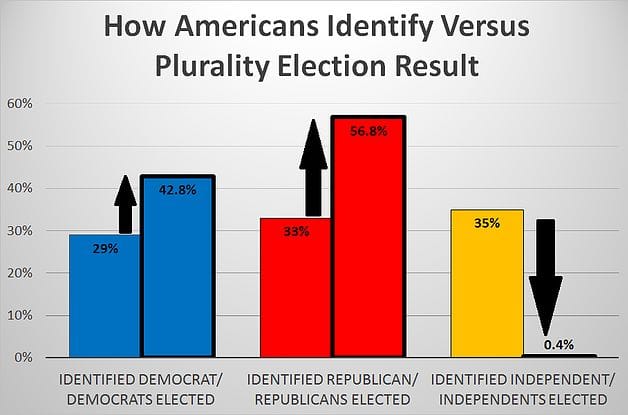
Rarely do we see a picture of just how out of sync things are. But you’re going to get that picture now. We’ve looked at the results from the congressional elections decided so far along with the standing seats, and we’ve compared who gets elected to how voters actually identify. Brace yourself. It’s bad:
8c56f6_7215cdfb40104601a34989f49ba00587.png_srz_p_628_415_75_22_0.50_1.20_0.00_png_srz

It’s clear who the beneficiaries are here: Republicans and Democrats. If you like those parties, then congratulations, because you’re on an especially long win streak.

But if you’re like the 35% that identify as independents or with a third party, then … it’s not looking so good. There are two independents in the U.S. Congress, U.S. Senators Bernie Sanders and Angus King. After this election, there are still only two.

There is, however, an independent candidate that looks like he could win in a governor's race: Bill Walker from Alaska. But keep in mind that Walker is winning under unique circumstances. His Democratic candidate dropped out and joined his campaign as a running mate. It’s not quite the same as going up against both parties.

So how do we keep independents and third parties from getting completely locked out?

One fix would be to use a proportional method (see our glossary). Proportional methods give seats to candidates proportional to the votes they get. If your favorite party got 10% of the votes, they’d also get 10% of the seats, for instance.

But to do a proportional method you need to elect many seats at-large. Staggered elections (See Article 1, Section 3 of the U.S. Constitution) keep this from happening in the Senate. And a federal law (Title 2, U.S.C.§2c) prohibits at-large elections for House seats.

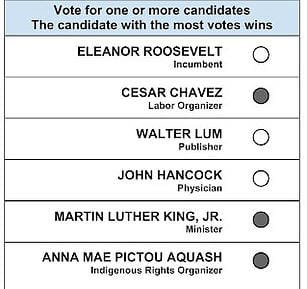
So for the time being, we’re stuck using winner-take-all (single-winner elections) for federal seats. With that being the case, we need to move away from our choose-one method, plurality voting. Our choose-one method pushes us to vote against independents, often failing to even explore them. And it’s not because voters aren’t interested — we can tell from the numbers that they are. Voters just don’t want to throw their vote away when they suspect their independent candidate won’t win.
8c56f6_247faee2cb14497a88ec051d2c9401d2.jpg_srz_p_307_289_75_22_0.50_1.20_0.00_jpg_srz

To be able to elect independents, voters need to feel that their vote will still be meaningful. That’s the only way voters will get their version of Bernie Sanders or Angus King for their state. Naturally, we have the answer: approval voting.

Approval voting lets you choose as many candidates as you want. (We are not talking about that ranking method you’re thinking of.) The nice part of being able to choose as many candidates as you want is that you can always choose your favorite, even if you’re not sure your (let's say) independent candidate can win. You can always choose an additional, more viable candidate simultaneously.

And with other people supporting independents, it gives those that choose not to vote — and those currently not registering to vote at all — a reason to go to the polls. Without approval voting, however, it’s hard to blame those stay-at-home (non)voters given the results we see. Under our choose-one method, independents are practically guaranteed to stay locked out of the picture.

Editor's note: This article was originally published on November 4, 2014 by the Center for Election Science and has been edited for publication on IVN.

Adhere to the IVN etiquette

By posting a comment, you agree to adhere to our etiquette rules: No partisan attacks, no personal attacks, substantiate your sources, no self-promotion.

Contact IVN

Questions about this article or our coverage? Send us a message. A free IVN member account is required.

Message sent

Thanks, we’ll review it and get back to you if needed.

Message not sent

Sorry, something went wrong. Please try again.

Sign in to send a message

Messages are tied to your IVN member account. Signing in is free and takes a few seconds.

Republish this article

Republishing guidelines

Republish IVN articles for free. Independent Voter News articles may be republished online or in print under a Creative Commons BY-NC-ND 4.0 license, on these terms:

  1. Credit the author and IVN. Keep the byline ("By Author Name, Independent Voter News") and the attribution note at the end, which links to the original.
  2. Keep the meaning. You may update time and place references and apply your house style. You may trim for length, as long as the cuts don't change the meaning or misrepresent the author. Keep the headline. Mark any additions as your own (for example "Additional reporting by ...").
  3. Translations are welcome. Translate faithfully, add "Translated from English by [your outlet]", and tell us at editor@ivn.us.
  4. Keep the links, including the link to the original article.
  5. Keep the tracking image. The HTML includes a 1-pixel image that counts readers on your page. It collects no personal information.
  6. Photos and illustrations. Images credited to IVN may be used with this article only. Images credited to others (AP, Getty, Unsplash, Wikimedia and so on) stay under their owners' terms. Secure the rights or switch "Include images" off.
  7. Don't sell it. You can't sell our articles or sell ads specifically against them. Your normal site advertising is fine.
  8. No implied endorsement. Don't suggest that IVN or the author endorses you, your candidates or your causes, or that donations to you support IVN.
  9. Keep labels. Opinion or analysis pieces keep that label.
  10. Point search engines to the original. Where your CMS allows, set the canonical URL to the original IVN article.
  11. No bulk or automated republishing, and don't submit our articles to aggregators (Apple News, Google News, MSN) as your own.
  12. Corrections and removals. Update your copy when we correct it, and remove it promptly if we ask. We'll contact you at the email you give us.
  13. Questions or print republication: editor@ivn.us.
Preparing the article

Election Day 2014: Independent Voters Locked Out Again

Choose a format
  • HTML
  • Email HTML
  • Markdown
  • Formatted (.docx)
  • Plain text
  • WordPress blocks
  • PDF
Choose a platform

Photos credited to others need their owners' permission.

Republishing somewhere else? Questions? editor@ivn.us