Skip to content
Subscribe

Facebook Graph Search Raises Privacy Concerns

Published:

In January, Facebook released Graph search, a function designed to allow users to tap into the vast amount of user information to search for specific results among friends based on specific criteria.

In a valiant effort to challenge Google's monopoly over search engines, Facebook Graph Search recognizes traditional keyword searches, but is also equipped with auto-complete options and the functionality to interpret grammar rules and their implications on search terms. The interface is also built to understand synonyms and related words, but is still in its infancy, with just "one percent" of the work complete, according to the Facebook engineering team.

What makes Facebook Graph Search Different?

Unlike Google search results, Facebook Graph Search produced highly personalized search results. While Google search results vary slightly and provide the option of including results from friends, Facebook Graph Search is structured around your friends on the social network. For example, you can search "Friends who live in New York," or "Restaurants my family members have been to in Madrid," or "People who like Daft Punk," and generate highly unique and personalized search results.

Facebook Graph Search allows you to use the Internet in a way that we previously didn't think possible, answering questions we previously didn't think the Internet was capable of. Instead of searching through each one of your friends' profiles on Facebook, checking their current city, Facebook does it for you. Facebook Graph Search pieces together information that would take us hours to do manually.

At What Cost?

The way Facebook presents Graph Search, which will soon be available to all 1 billion of its users, seems too good to be true, or at least too good to be free. As with most consumer-based products, it does come at a cost: the cost of privacy.

Marketo put together this infographic mapping Facebook Graph Search's effects on your privacy. With 28 percent of users sharing all, or almost all, of their wall posts with an audience wider than just their friends and 13 million Facebook users reporting to have never touched their privacy settings, now might be the time to re-evaluate what you share on the social network.
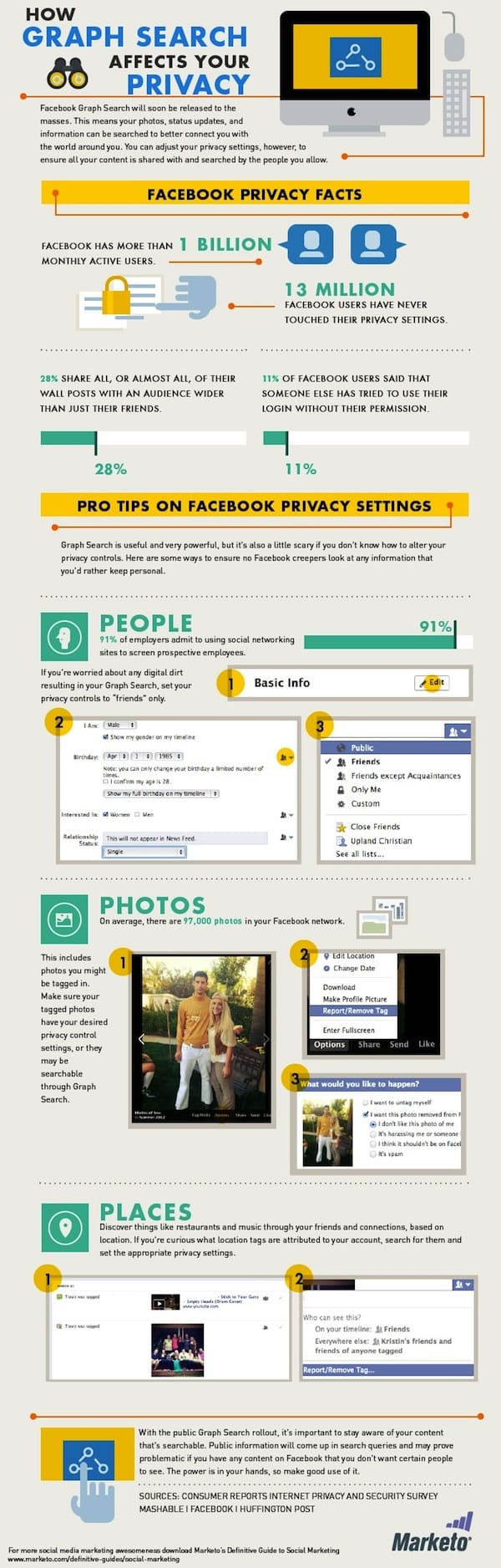
Facebook Graph Search Privacy 1

Adhere to the IVN etiquette

By posting a comment, you agree to adhere to our etiquette rules: No partisan attacks, no personal attacks, substantiate your sources, no self-promotion.

Contact IVN

Questions about this article or our coverage? Send us a message. A free IVN member account is required.

Message sent

Thanks, we’ll review it and get back to you if needed.

Message not sent

Sorry, something went wrong. Please try again.

Sign in to send a message

Messages are tied to your IVN member account. Signing in is free and takes a few seconds.

Republish this article

Republishing guidelines

Republish IVN articles for free. Independent Voter News articles may be republished online or in print under a Creative Commons BY-NC-ND 4.0 license, on these terms:

  1. Credit the author and IVN. Keep the byline ("By Author Name, Independent Voter News") and the attribution note at the end, which links to the original.
  2. Keep the meaning. You may update time and place references and apply your house style. You may trim for length, as long as the cuts don't change the meaning or misrepresent the author. Keep the headline. Mark any additions as your own (for example "Additional reporting by ...").
  3. Translations are welcome. Translate faithfully, add "Translated from English by [your outlet]", and tell us at editor@ivn.us.
  4. Keep the links, including the link to the original article.
  5. Keep the tracking image. The HTML includes a 1-pixel image that counts readers on your page. It collects no personal information.
  6. Photos and illustrations. Images credited to IVN may be used with this article only. Images credited to others (AP, Getty, Unsplash, Wikimedia and so on) stay under their owners' terms. Secure the rights or switch "Include images" off.
  7. Don't sell it. You can't sell our articles or sell ads specifically against them. Your normal site advertising is fine.
  8. No implied endorsement. Don't suggest that IVN or the author endorses you, your candidates or your causes, or that donations to you support IVN.
  9. Keep labels. Opinion or analysis pieces keep that label.
  10. Point search engines to the original. Where your CMS allows, set the canonical URL to the original IVN article.
  11. No bulk or automated republishing, and don't submit our articles to aggregators (Apple News, Google News, MSN) as your own.
  12. Corrections and removals. Update your copy when we correct it, and remove it promptly if we ask. We'll contact you at the email you give us.
  13. Questions or print republication: editor@ivn.us.

IVN staff: fill in who you're inviting above, then create the invite.

Preparing the article

Facebook Graph Search Raises Privacy Concerns

Choose a format
  • HTML
  • Email HTML
  • Markdown
  • Formatted (.docx)
  • Plain text
  • WordPress blocks
  • PDF
Choose a platform

Photos credited to others need their owners' permission.

To for

Republishing somewhere else? Questions? editor@ivn.us