
According to a Gallup poll released on July 24,
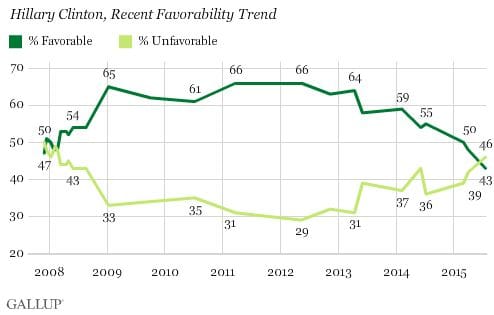
Hillary Clinton's favorability has continued to drop to a net unfavorable position -- even with her remaining head and shoulders above the rest of the Democratic pack in both favorability and name recognition.
For the first time since the 2008 election, Clinton polls with an "unfavorable" (46-43) status nationwide among all voters. But this drop might not matter much when comparing Clinton to her opposition.
This election is going to come down to which candidate can grab those critical points in a handful of battleground states; the smallest of percentages in 7 or 8 states might be the difference between victory or loss. Within these critical points are the swing voters, the moderates, and the independents, who historically don't gravitate toward the far left or far right in elections.
While Republicans are fielding a huge number of candidates -- 16 declared -- there are very few willing to campaign on appealing to the "middle" after Mitt Romney's resounding defeat in 2012.
Even Jeb Bush, who was once seen as a more moderate choice, has been courting far-right ideals -- such as eliminating Medicare -- to try to gain momentum in the 2016 race.
As far as center appeal goes, the Democrats are even worse this election cycle.
Of the 5 Democrats running, three-fourths of Americans don't even know or have an opinion on the three bottom listers: O'Malley, Webb, and Chafee.
Martin O'Malley's recent dabbling into gerrymandering, and the subsequent trials, make him about as damaged as a Democrat could possibly be to the party faithful.
Jim Webb has all the credentials a Democrat could ever want -- decorated war hero, solid service in the Senate, secretary of the Navy during the Reagan administration, and a prolific writing career.
What Webb doesn't have is a solid message, national appeal, and a national framework for winning the primary.
Lincoln Chafee has the appearance of a growing number of politicians willing to switch political allegiances whenever convenient, and is a hodgepodge of political beliefs that really doesn't fit within any political framework.
And then there's Bernie Sanders and Hillary Clinton, both embracing -- to varying degrees -- the new Democratic populist strategy.
The socialist/populist strategy is an old-hat for Sanders, who has been running on these values since his first attempt at office in 1971. And other than living on an Israeli commune (kibbutz) and dabbling in political smut writing in the style of Henry Miller, Sanders has been a career politician in one of the "bluest" of the blue states. How Sanders would fare in the "purple" battleground states is impossible to predict, and the primary will be a tell-tale sign.
There has also never been a Jewish president or vice president in American history. However, the 2000 election seemed to indicate that it would be a non-issue politically.
Hillary Clinton, a more recent convert to the new progressive strategy, has gone all-in with her "Four Fights For You" strategy.
But Clinton comes with 20-plus years of baggage associated with being in the political spotlight. Clinton's strength, even with the baggage, will be in her ability to keep the party in lockstep, something that Sanders is unlikely to be able to accomplish.
This new progressive campaigning style is not without its risks, and could severely backfire on the Democrats.
If the Republicans can field a candidate with a strong economic agenda, tough immigration policy, and trade agenda favoring American products, the so-called Reagan-Democrats in the Rust Belt would almost certainly defect from the Democrat's progressive strategy.
This would almost certainly lose the election for the Democrats, as there is no path to victory without the Rust Belt.
The sad reality is, no matter how unfavorable Clinton might become, it will all depend on the candidate she faces in the general election -- because moderates, swing voters, and independents may be voting more as a statement against her opponent than for her, her appeal, or her message.
Photo Source: Reuters