
When someone wins an election with fewer than half the votes, what do you think? Many would call this winner undeserving. After all, they didn’t get a majority.
You know how a majority works. Right? Maybe not. In the world of voting theory, A LOT is counterintuitive—including the concept of majority. So get a chair because you’ll need to get comfortable for this one. Pie Chart

An Introduction to Majority
Let’s get some terminology out of the way. There are at least three terms that get at the idea of majority when talking about voting.
Plurality. Plurality means having more first-preference votes than any other candidate but not necessarily more than half. Note that this is the concept of a plurality, which is different than the actual voting method, plurality voting. (Plurality voting is the seemingly-everywhere voting method that has us choose only our first-preference candidate.)
Absolute majority. An absolute majority means a candidate has received more than half the first-preference votes. It’s impossible to guarantee an absolute majority under any voting method when there are more than two candidates because that candidate will not always exist.
Condorcet winner. A Condorcet winner is a candidate who can beat every other candidate in a head-to-head race. Condorcet winners are typically determined using a ranked ballot, though you can also use information from scored ballots to simulate a Condorcet winner. If you have an absolute majority winner, then that person is also your Condorcet winner. If you have a Condorcet winner, there still may not necessarily be an absolute majority winner.
Not strange enough yet? A Condorcet winner also doesn’t always exist. The absence of this winner is called a cycle or a Condorcet paradox. Imagine candidates that interact like the game Rock-Paper-Scissors and you get the idea.
Finally, just for the heck of it, let’s toss in a multi-winner bonus concept for the end.
False (aka Manufactured) Majority. A false majority typically refers to entire legislatures. This is when a party gets more than half the seats yet they get fewer than half the votes. These peculiarities happen more than 40% of the time with winner-take-all systems. Winner-take-all systems are election systems that exclusively use single-winner districts when electing a legislature or parliament.
Does the concept of “majority” sound as straightforward now? The two ideas that sound intuitively nicer—absolute majority and Condorcet winner—don’t always exist and nobody seems to like a mere plurality winner. When there are more than two candidates, no voting method can guarantee an absolute majority or Condorcet winner.
But you say you have an example of a voting method that guarantees a majority? Using a runoff, you say? Let’s explore.

The Runoff and Majority
A runoff is regular choose-one plurality voting where the top two candidates go to the next round. If a candidate has more than half the votes in the first round, however, then there’s no runoff. The catch is that using plurality voting in the first round can eliminate a good candidate. It can do this by squeezing out the middle candidate, someone with strong consensus support. See the illustration below.
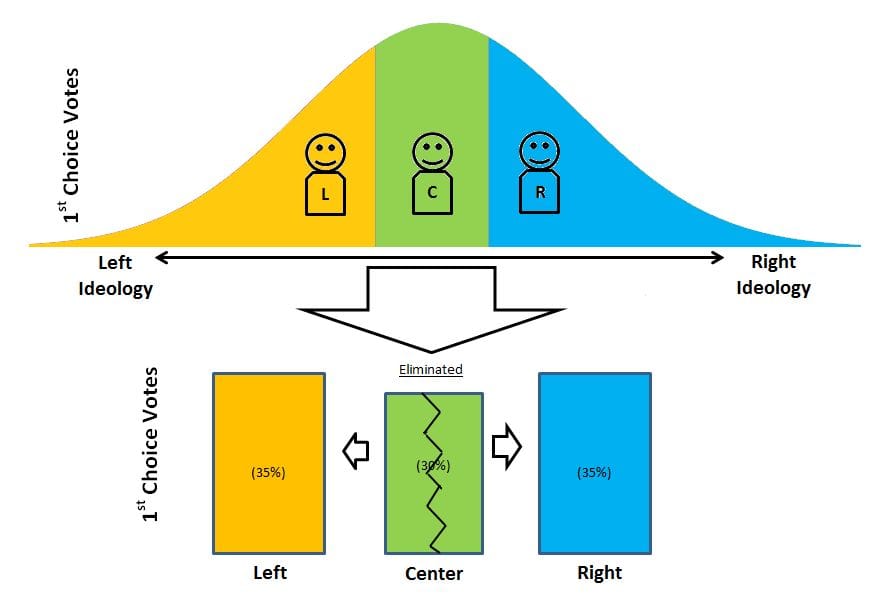
Normally you see just the plurality-voting results of the middle candidate. Plurality voting makes that middle candidate look bad: you only see the dismal vote total and dismiss the losing candidate as poor. But had voters provided you with more data, then you could have seen that they just eliminated the candidate who could beat everyone else head-to-head—the Condorcet winner.
What you actually saw was a candidate who lost in the first round because of an artificially low vote count. The first plurality voting round split the votes on either side of the moderate. Then you saw a runoff between the two candidates who in the first round split the vote on just one side of their political spectrum. And between those two remaining candidates, one candidate got an absolute majority.
That last part is what fools people.
Here’s the issue: you can always get an absolute majority winner when there are just two candidates. The problem is who you knock off to get to those last two candidates and whether one of the candidates you knocked off was actually someone you should have kept. The mere fact that you have two candidates left in the end is meaningless.