Skip to content
Subscribe

Meet The 8 Senators Who Voted Against the NDAA

Meet The 8 Senators Who Voted Against the NDAA
Published:

We talk about the political divide in Washington and the gridlock that prevents anything from getting done on Capitol Hill. Yet, if there is one thing both parties can agree on, it is the topic of defense, war, and foreign policy.

That was evident this week when the Senate approved the National Defense Authorization Act in a 89-8 vote. The bill authorizes $700 billion in military spending for the next fiscal year.

The US is now on track to have the largest military budget in the decade-plus wars in Iraq and Afghanistan. The bill would require Congress to repeal budget caps on several federal agencies, including the Pentagon, passed in 2011.

Yet there was notable opposition in the Senate on both sides of the aisle to this massive increase in military spending.

US Sens. Bob Corker (R-Tenn.), Kirsten Gillibrand (D-NY), Patrick Leahy (D-VT), Mike Lee (R-Utah), Jeff Merkley (D-Ore.), Rand Paul (R-Ky.), Bernie Sanders (I-Vt.), and Ron Wyden (D-Ore.) bucked the partisan establishment and voted no on the bill.
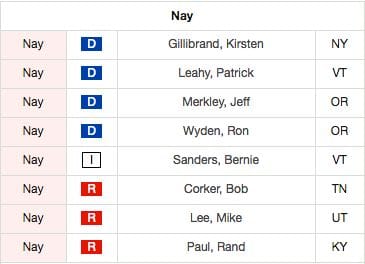
Image Source: GovTrack.us

For those who know these lawmakers, their opposition may not come as too much of a surprise.

US Sen. Rand Paul, for instance, has long taken a stance of sobering the nation's foreign policy and approach to war and military operations.

Paul introduced an amendment to the 2018 NDAA that would have repealed the 2001 and 2002 resolutions authorizing the use of military force (AUMF) for the wars in Afghanistan and Iraq.

Paul's amendment was defeated, but he noted on the Senate floor, "For the first time in 15 years, we are debating the congressional role in the declaration of war."

US Sen. Bernie Sanders also has a fairly consistent voting record on defense spending. He has voted no on nearly every NDAA in the past 10 years.

"Foreign policy is about U.S. government budget priorities," said Sanders during a foreign policy speech at Westminster College in Fulton, MO.

Sanders often priorities domestic issues -- like health care and anti-poverty programs -- over defense when it comes to the federal budget.

The NDAA has long had bipartisan support. It doesn't seem to matter how much is spent or where the money goes, the NDAA has an impressive 55-year track record of passing in Congress.

There may be good things about the 2018 NDAA. There may be bad things. Very few people know because the issue gets very little discussion in Congress and in the media.

With such a huge increase in spending, we should have a discussion about why this increase is needed and where the money is going.

Adhere to the IVN etiquette

By posting a comment, you agree to adhere to our etiquette rules: No partisan attacks, no personal attacks, substantiate your sources, no self-promotion.

Contact IVN

Questions about this article or our coverage? Send us a message. A free IVN member account is required.

Message sent

Thanks, we’ll review it and get back to you if needed.

Message not sent

Sorry, something went wrong. Please try again.

Sign in to send a message

Messages are tied to your IVN member account. Signing in is free and takes a few seconds.

Republish this article

Republishing guidelines

Republish IVN articles for free. Independent Voter News articles may be republished online or in print under a Creative Commons BY-NC-ND 4.0 license, on these terms:

  1. Credit the author and IVN. Keep the byline ("By Author Name, Independent Voter News") and the attribution note at the end, which links to the original.
  2. Keep the meaning. You may update time and place references and apply your house style. You may trim for length, as long as the cuts don't change the meaning or misrepresent the author. Keep the headline. Mark any additions as your own (for example "Additional reporting by ...").
  3. Translations are welcome. Translate faithfully, add "Translated from English by [your outlet]", and tell us at editor@ivn.us.
  4. Keep the links, including the link to the original article.
  5. Keep the tracking image. The HTML includes a 1-pixel image that counts readers on your page. It collects no personal information.
  6. Photos and illustrations. Images credited to IVN may be used with this article only. Images credited to others (AP, Getty, Unsplash, Wikimedia and so on) stay under their owners' terms. Secure the rights or switch "Include images" off.
  7. Don't sell it. You can't sell our articles or sell ads specifically against them. Your normal site advertising is fine.
  8. No implied endorsement. Don't suggest that IVN or the author endorses you, your candidates or your causes, or that donations to you support IVN.
  9. Keep labels. Opinion or analysis pieces keep that label.
  10. Point search engines to the original. Where your CMS allows, set the canonical URL to the original IVN article.
  11. No bulk or automated republishing, and don't submit our articles to aggregators (Apple News, Google News, MSN) as your own.
  12. Corrections and removals. Update your copy when we correct it, and remove it promptly if we ask. We'll contact you at the email you give us.
  13. Questions or print republication: editor@ivn.us.
Preparing the article

Meet The 8 Senators Who Voted Against the NDAA

Choose a format
  • HTML
  • Email HTML
  • Markdown
  • Formatted (.docx)
  • Plain text
  • WordPress blocks
  • PDF
Choose a platform

Photos credited to others need their owners' permission.

Republishing somewhere else? Questions? editor@ivn.us