
by Bob Warhover
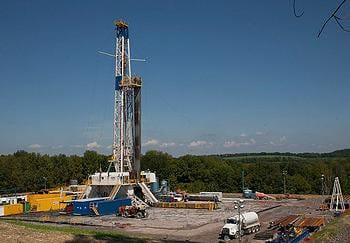
A fracking rig in Bradford County, Pennsylvania // Credit: Appvoices.org
Hydraulic fracturing, or “fracking” as it has come to be known in the popular lexicon, is the process of drilling and injecting fluid into the ground at a high pressure in order to fracture shale rocks so they release the natural gas or oil inside. Despite the relatively recent emergence of the term, fracking has been successfully utilized in commercial operations since the late 1940s.
However, the process remained largely untapped until the last decade, as newly available technologies have allowed for wider corporate margins in the utilization of the technology. As global demand for energy has skyrocketed over the past generation, the coincidence of rising oil prices and falling costs of natural gas exploration through the use of fracking has lead to a surge in the use of the hydraulic technology. In the same way that the Middle East has economically benefited from oil reserves, the United States hopes to benefit from its large potential for use and export of natural gas through fracking.
Although the use of fracking does provide the potential for great economic optimism, one must also take into account the prospective negatives before embarking on a large-scale use or state approval or subsidization of the technology. American families are still recovering from the economic turmoil begotten by the “Great Recession” of the past decade, and the hopes of employment and lower costs to consumers are difficult to ignore.
IHS Cambridge Energy Research Associates reported this week that in 2012, the energy boom supported 2.1 million jobs, added almost $75 billion in federal and state revenues, contributed $283 billion to the gross domestic product, and lifted household income by more than $1,200. At a time of tepid economic recovery and more than 4 million Americans receiving welfare and nearly 47 million on food stamps, it is difficult to take the “moral high ground” and oppose the potential economic benefits of fracking.
Despite the generally accepted economic benefits of fracking, there is little dissent that perpetuating a system of non-renewable energy is not without risk. Injecting water, sand and chemicals into the ground at high pressure to create pathways for trapped oil and gas to escape can tamper with watersheds beneath the surface of the drilling sites and, eventually, possibly infect the nearby lands with the oils and gases meant to be extracted.
Research published in Proceedings of the National Academy of Sciences, on the impact of drilling in the Marcellus Shale, which stretches from north-eastern Pennsylvania to southeastern New York, found that four-fifths of nearby wells contained methane and that concentrations of gas in the water in nearby homes were far higher than in those further away.
Contaminated well water is used for drinking water for nearby cities and towns. Other studies have found over 1,000 documented cases of water contamination next to areas of gas drilling as well as cases of sensory, respiratory, and neurological damage due to ingested contaminated water. Additionally, less than half of the fracturing fluid is reported to be recovered, the rest of the toxic fluid is left in the ground and is not biodegradable. Though not all wells throughout the United States have been contaminated in the last decade, one must wonder what the future repercussions of such actions will be.
The current debate on fracking is consequential as worldwide production of natural gas is forecast to grow by 50 percent by 2035, with shale and other “unconventional” sources accounting for two thirds of the growth. Much of the media’s coverage of the fracking debate frames the issue as a Hobson’s choice between speculative economic gain on the one hand and a continuing of the perpetual destruction of bucolic landscapes and access to clean watersheds on the other. Even environmentalists need not be diametrically opposed to fracking.
Natural gas is cleaner than fuels such as coal. The International Energy Agency reports that America’s carbon emissions fell by 450m tonnes in the five years prior to 2012, partly because coal was swapped for the gas made available by fracking. In Europe, where expensive gas has led to greater reliance on coal-fired power stations, emissions have not fallen by much. Careful regulation can reduce risks by ensuring that well-shafts are leak-proof and that regurgitated gunk is safely collected. The International Energy Agency reckons that proper regulation would add just about 7 percent to the cost of each shale-gas well.
Few of the pundits seem to indicate that there in fact exists a clear middle ground. Establishing a fully effective system of safeguards for hydraulic fracturing to protect our health while still allowing fracking and natural gas exploration can allow for access to energy from sources cleaner than coal. Meanwhile, technology that allows for cheaper, safer, and renewable energy sources can still develop at the same time.
On this issue at least, the media seems to be perpetuating only parts of the story on fracking, a practice antithetical to our democratic system of government. It seems too often that this is par for the course in an information age where informed civil discourse has seemed to have gone the way of the printing press. It has yielded to an ideological punditry that speaks only in agreed-upon talking points and too often misinforms the public on important information. Is it too much to ask that our elected officials know the whole story before they render decisions that may irrefutably alter both our planet and economies? Only time will tell whether reasoned pragmatism will be allowed a moment at the table before America reaches a decision on fracking.