
Washington State has held nonpartisan top 2 open primaries since 2008 following the US Supreme Court decision (7 – 2) declaring that Washington’s Initiative 872 was constitutional. With three major election cycles complete, we can draw some conclusions based on primary and general election results.
All election data presented in this blog was obtained from the Secretary of State Elections Division website. We analyzed US Representative, State Senate, and State Representative races. FloridaIndependentVoting.Org is solely responsible for the analysis shown below.
How well is Washington’s Nonpartisan Top 2 Election System working?
Incumbency
According to The Center for Responsive Politics, incumbent US Congressional re-election rates for US Representatives are typically above 93 percent (7% turnover) and above 85 percent (15% turnover) for US Senators in the period 2000 - 2012.
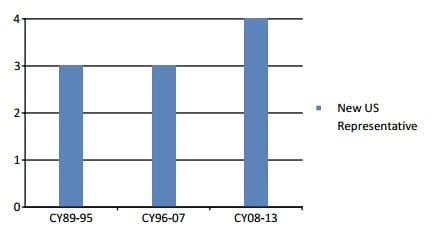
From 2008 – 2012/13, Washington’s US Representatives had a turnover rate of 40 percent. Compared to the national average of 7%, "Top-Two" is demonstrating a significant increase in competitive races. Number of competitive races increase after top-two
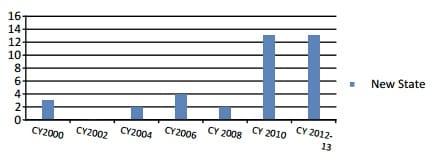
Washington’s State Senator turnover increased significantly in 2010 and 2012-13 (26.5% average) compared to the national average of 15% turnover on an annualized basis. From 2008 through 2012, cumulative turnover was 57 percent. Washington State Senators serve four year terms with half of the seats up for re-election every two years. Washington State Senator turn-over percentage over time
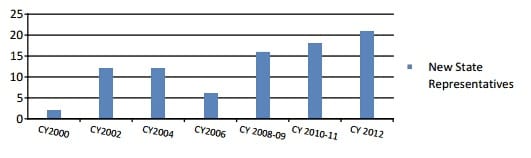
From 2008 - 2012, Washington State Representative turnover has shown a steady increase. Average turnover was 18 percent for an incumbency rate of 82 percent -- far better than a 93 percent incumbency rate for US Representatives. From 1990 through 2006 cumulative turnover was 32 percent. From 2008-2012 cumulative turnover was 56 percent. Clearly incumbents are facing greater competition for re-election under Top 2. Number of new representatives elected by year
Opponents of Top 2 are claiming all sorts of bad outcomes based on speculation. We examined Washington State elections before and after Top 2 introduction in the following areas: multi-candidate races; number of races that included No Party Affiliation (NPA) or independent candidates; unopposed races, number of single party races and voter turnout.
Multi-candidate Races
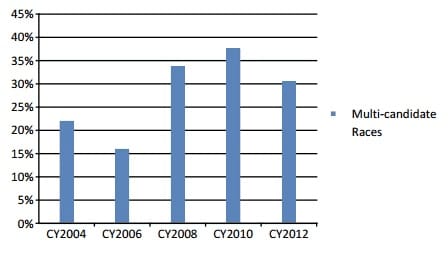
Once nonpartisan elections started in 2008, the multi-candidate races trended significantly higher. Multi-candidate races include any race where more than 2 candidates appeared on the ballot regardless of party affiliation or lack of affiliation. All US Representative races were multi-candidate races.
In one multi-candidate race, the second place candidate in the primary actually won the General Election. Without top 2 this candidate wouldn’t have had that second chance. A similar race occurred in California where a second place finisher in the nonpartisan top 2 Primary won the General Election. In the California race, the winner defeated a 20 term incumbent US Representative.
Even more significant in the California race is the fact that a hardline Democrat was replaced by a more moderate Democrat. Top 2 is about better choices. Michael Higham made this point in his comment on our recent article on Florida legislative change. While single examples are anecdotal they illustrate the future potential of Top 2 to generate more competitive races. Percentage of multi-candidate races in Washington
Independent, NPA, and Minor Party Candidates
Independents and No Party Affiliation (NPA) candidates have started a small trend in the right direction but still have a long way to go compared to the continued dominance of the two major parties. No independents or NPA candidates won a race.
The same is true for minor party candidates.
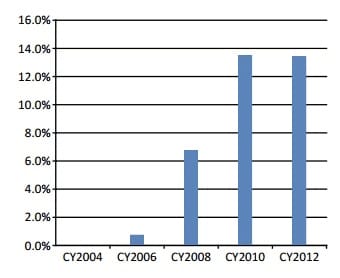
Minor party candidates were present in just over 6 percent of the races but averaged over 30 percent of the vote against established major party candidates. There is a definite move toward more candidates and more competition even if Independents and minor party candidates aren’t winning today. Top 2 is about changing the political culture from party control to voter control. Percentage of no party and third party candidates running for office
Unopposed Safe Seat Elections
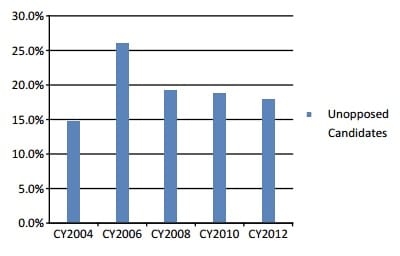
Washington State has seen a slight decrease in unopposed races with introduction of the Top 2 elections. From 2008-2012, unopposed candidates averaged 18 percent of the total election races based on 123 to 133 races depending on election year. Compared to Florida in 2012, where “safe” seats in the Legislature exceeded 72 percent, Washington’s results are encouraging. Percentage of unopposed races in Washington
Single Party Races
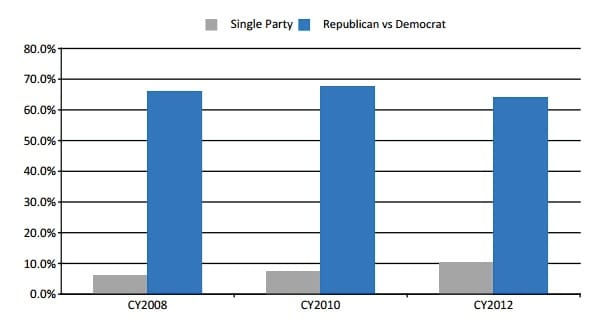
Opponents of this system speculate that a substantial number of General Election races would be dominated by head-to-head single party races. The chart below shows single party races to be a small percentage of the total.
For example, in 2012 there were 14 single party races (10% of total races). Of those 14 races, 79 percent were single party elections in the primary as well. Republican versus Democrat races dominated every year with over 64 percent of the races between the two major parties.
By comparison, the 2012 nonpartisan open primaries in California resulted in a General Election with only 18 percent of all races between candidates of the same party. Our overall conclusion is that single party races are a minor concern. Single party and Rep vs Dem races in Washington
Voter Turnout
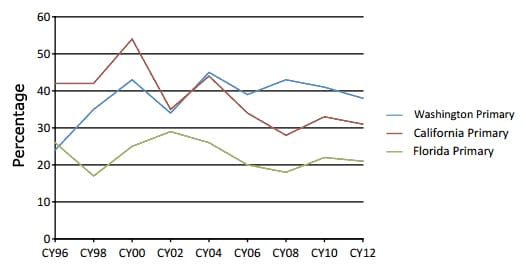
Voter turnout is another area where opponents of Top 2 state that primary election turnout has not increased. They are right depending on how you measure success. Washington state’s average primary election turnout from 1996-2006 was 37 percent. Since Top 2 began in 2008, average turnout was 41 percent, a 4 percent increase in turnout.
There is no question that turnout needs to be increased in primary elections, but Washington’s experience is a positive trend.
The chart below shows an interesting contrast between Florida and the Top 2 states. Florida achieves a consistently lower voter turnout than California and Washington state. Florida average voter turnout was 16% less than Washington State. Voters are not exercising their good citizen responsibility given these numbers.
According to Washington State’s Supervisor of Elections office, voter apathy is a known problem that transcends the type of election held by a state. The primary purpose of Top 2 is to open the door to all voters and more candidates therefore more choices for voters. This is an area for all voters to understand and exercise their constitutional responsibility. Florida primary elections have less participation than California or Washington
In conclusion, Top 2 doesn’t solve all of the problems with Florida’s election system and incumbent office holders. Top 2 isn’t perfect, but offers an opportunity for candidates to emerge that aren’t wedded to major party ideologies and extremist positions on important problems. It provides a building block for our citizens to have a greater choice in candidates and a greater voice in government.
Top 2 is a relatively new type of election so the results shown above should be considered preliminary, but with interesting trends.
- Incumbent turnover has increased since Top 2 began
- Single party races have shown to be a minor concern
- NPA, Independent, and minor party candidates have increased, but need to be more competitive
- Unopposed candidate races declined slightly, but could stand to be improved
- Primary election turnout needs to be increased to reflect the wishes of a majority of voters
When Benjamin Franklin was leaving the Constitutional Convention in Philadelphia, he was asked what type of government the 13 colonies were going to have. He responded, “A Republic if you can keep it.” Our challenge is to preserve our Republic.