
Credit: User generated electoral maps on 270towin.com
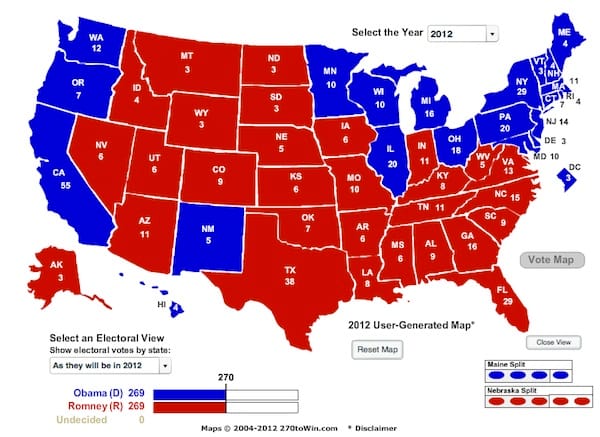
It’s the morning of Wednesday, November 7, 2012, and every major news outlet is reporting that for the first time in nearly two centuries, there is a tie in the electoral vote. Both Mitt Romney and Barack Obama have secured 269 votes. Fire begins to rain down from the sky, the ground begins to quake, and Republicans and Democrats lose their minds.
Okay, so maybe the imagery of apocalyptic events is bit extreme, but the reaction people will see in the wake of reports that there is a projected tie in the Electoral College would make it seem like the world is being torn asunder. While this outcome is unlikely, the first question of whether it is possible can be answered with an indisputable “yes.”
So, what happens if there is an electoral vote tie on November 6?
The Constitution of the United States has a contingency measure in place in the event neither presidential candidate can reach the 270 threshold. Article II, Section 1 states:
“The person having the greatest number of votes shall be the President, if such number be a majority of the whole number of electors appointed; and if there be more than one who have such majority, and have an equal number of votes, then the House of Representatives shall immediately choose by ballot one of them for President; and if no person have a majority, then from the five highest on the list the said House shall in like manner choose the President. But in choosing the President, the votes shall be taken by States, the representation from each state having one vote; A quorum for this purpose shall consist of a member or members from two thirds of the states, and a majority of all the states shall be necessary to a choice. In every case, after the choice of the President, the person having the greatest number of votes of the electors shall be the Vice President. But if there should remain two or more who have equal votes, the Senate shall choose from them by ballot the Vice President.”
There are additional stipulations laid out in the Twelfth Amendment and the Twentieth Amendment.
The results people hear on election night or on the Wednesday after Election Day are projected results. They are not official. The Electors will meet on the third Monday of December, which is December 17, 2012. Roughly half the states have laws that require their Electors to vote for the candidate that won the popular vote in their state. In a state that does not have such laws in place, an Elector could decide to change their vote if the popular vote is very close.
In the event of a projected tie in the Electoral College, one Elector could change everything by switching their vote. In this scenario, the vote would then become 270-268, giving the advantage to one campaign over the other. The lack of restrictions on Electors in some states means that not every state is guaranteed "winner take all." Most experts say this is highly improbable, but there have been instances in the past when an Elector has changed their vote.
The race between Mitt Romney and Barack Obama has not only been one of the closest presidential elections Americans have seen in many years, but it is also one of the ugliest. It is likely that if the tie scenario becomes a reality we could see a repeat of 2000, but on a much more massive scale. There would probably be lawsuits over voting results in more than one state and the relevance of the Electoral College would become a major part of the national dialogue.
Most political analysts speculate that if there is a tie in the Electoral College the election would remain undecided until the new Congress convenes in a joint session on January 6, 2013 to count the electoral votes. This is something that happens after every presidential election and if neither candidate has 270 electoral votes then that is when things get really interesting.
The constitution gives the authority to select the new President of the United States to the US House of Representatives if there is an electoral tie. The House does not select the presidential ticket or the campaign. House members would pick the president only because the constitutional authority to select the Vice President of the United States belongs to the US Senate.
Imagine a situation where Republicans keep the House, but cannot gain control of the Senate or make it a 50-50 split. This is a situation that favors Romney, but does not help his running mate. As polarized as this Congress has been, it is not completely far-fetched to imagine a divided White House if the Democrats have decisive control of the Senate and the Republicans keep their majority in the House.
Under the assumption that there are eleven battleground states (CO, FL, IA, MI, NC, NH, NV, OH, PA, VA, WI), there are thirty-two possible electoral tie combinations for 2012. However, if people considered the most current polling trends, the likely scenario seems to be that Romney would need to break the tie in Virginia, take Colorado, reverse trends in Nevada, and Obama would have to secure Ohio.
How likely is an electoral tie?
Even in a race as tight as the 2012 presidential race between Mitt Romney and Barack Obama, it is still statistically unlikely that there will be an even split in electoral votes. However, this is still going to be a very close race. Americans may not know who their next president is going to be at the end of election night. The two biggest states to watch right now are Ohio and Virginia.